Product sampling marketing involves providing a product or service for free to a select group of potential customers and asking them to write a review after using it.
In Korea, ??? ??? or product sampling marketing channel refers to the platforms or media where this type of marketing is conducted. These reviews can be posted on individual social media channels like blogs, Instagram, and YouTube, or on the product’s sales page.
More than 7 out of 10 (72%) buyers find online reviews most helpful when making a purchase decision. Additionally, respondents indicated that company websites and marketing materials are the most useful, and over half found advertisements and blogger recommendations helpful during their purchasing process (source: Online Reviews Most helpful when making a purchase decision – Product Review Monitoring)
Product sampling marketing gives consumers the opportunity to indirectly experience a product or service before purchasing it, which can stimulate their desire to buy and increase conversion rates. In fact, a survey found that 72% of consumers said reviews helped them make a purchase decision.
It’s no exaggeration to say that all potential customers undergo a verification process before making a purchase decision. The act of searching has become a part of daily life. Even for purchasing a toothbrush, encountering more than ten different pieces of content is the norm.
Product sampling marketing also helps widely disseminate information about products or services to consumers. Participants in product sampling are more likely to write positive reviews than negative ones.
Many companies engage in product sampling marketing to spread positive experiences with their brand and products. However, poor management can lead to negative outcomes.
In Korea, Product sampling marketing platforms include Naver, Instagram, and YouTube. Each platform has its own strengths and weaknesses, so it’s important for companies to choose one that matches the characteristics of their product or service.
Naver Blog Product Sampling
Advantages
Large user base
Targeted marketing through search functions
Variety of product sampling programs
Product sampling management systems
Disadvantages
High competition makes search exposure challenging
Naver, being the largest portal site in Korea, has users of various ages. Therefore, using Naver for product sampling marketing is effective for products or services with a broad target audience. Koreans tend to perceive Naver search results as authoritative and reliable.
Naver’s search functions allow effective targeting of potential customers, and it provides various product sampling programs and management systems for efficient marketing operations. However, because there are so many blog posts, it can be difficult for product sampling posts to stand out in search results.
Companies must carefully select their product sampling participants and strategically plan to ensure their posts appear in searches.
Instagram Product Sampling
Advantages
High usage among young women
Ideal for image and video content
Can be integrated with influencer marketing
Disadvantages
Difficult to target customers
Instagram is popular among younger users and is ideal for image and video content. Therefore, its effective for marketing products or services targeting young people through Instagram product sampling. Instagram can also be linked with influencer marketing for greater impact since users often see Instagram’s brand evaluations as trends.
However, Instagram users dont frequently use the platform based on searches, making targeting challenging. Companies should consider strategies involving relevant hashtags or influencer-driven product sampling to reach their target audience.
YouTube Product Sampling
Advantages
Ideal for securing video content
Marketing based on subscribers
Disadvantages
Difficult targeting
High cost
YouTube is a video content platform that is effective for stimulating purchase desires and increasing conversion rates through video reviews that highlight product or service features. Marketing based on subscribers helps secure a loyal customer base.
Choosing the Right Product Sampling Marketing Channel
To achieve effective results with product sampling marketing, consider the following:
Clearly define your marketing goals and choose the appropriate channel.
Recruit product sampling participants that align with your marketing objectives.
Systematically manage the participants to ensure they use the product or service and write reviews.
Utilize data analysis to measure and improve the effectiveness of product sampling marketing.
This article has explored the channels to consider before starting product sampling marketing. It is a powerful strategy to receive real-life user reviews, but choosing the wrong channel can lead to significant time and financial losses.
By analyzing your target audience and choosing the right channel, you can attract more potential customers. It is crucial to actively understand the market and apply this knowledge to your marketing efforts.
Product Sampling Marketing Channel – FAQ
Who should be targeted for product sampling? For social media-based platforms, target social media users. For specific product or service targets, choose specialized product sampling platforms.
What are the cost models for product sampling marketing platforms? There are both free and paid models. Select a platform that fits your marketing budget.
How to compare product sampling marketing platforms? Larger platforms with more traffic make recruiting participants easier and increase review exposure. Higher quality participants provide more reliable reviews. Utilize the data analysis features provided by platforms to measure and improve marketing effectiveness.
How to maximize the effectiveness of product sampling marketing platforms? Clearly set your marketing goals, choose the right platform, and develop a marketing strategy. Utilize the participant recruitment features of the platform to gather participants that match your marketing goals.
Growth Marketing Agency manages product sampling participants to ensure they use the product or service and write reviews. Additionally, we analyze data to measure the effectiveness of product sampling marketing and actively use the insights gained.
The significance of content marketing is increasingly being highlighted across all types of businesses. Whether it’s a small startup or a large corporation, investing in high-quality content is crucial for fostering sustainable business growth.
In this article, we will explore the various benefits of content marketing and why it is essential for businesses aiming to succeed in today?s online environment.
From improving search engine rankings and driving organic traffic to nurturing leads and guiding them through the sales funnel, we will discuss why content marketing is more important than ever.
Understanding the Importance of Content Marketing: Business Advantage
Building Trust and Providing Value to Your Audience
Creating and sharing valuable, informative content that aligns with your audience?s interests can provide real value by addressing their needs and problems. This helps in establishing trust and credibility by demonstrating your expertise and willingness to assist your customers.
Consistently delivering high-quality content positions you as a reliable source of information and an industry leader. This can attract and retain customers who are likely to seek your guidance and support.
At Growth Marketing Agency, we share the content we publish on social media to drive its distribution. Example from our Korean social medial account.
Additionally, sharing content across social media and other platforms helps in reaching a larger audience, enhancing content visibility, and boosting brand reputation. When others recognize that you provide valuable content and resources, they are more likely to view you as a trustworthy and credible source of information.
Positioning Your Business as an Industry Leader and Demonstrating Expertise
By creating and sharing high-quality content that addresses your target audience?s needs, you can prove your expertise. This helps position your business as a leader in the industry. This can help attract new customers who are more likely to seek your guidance and support.
Effective content marketing also helps in retaining customers by continuously providing value. By regularly offering valuable content, you can keep customers engaged and interested in your business over time.
Understanding the Importance of Content Marketing02. Differentiating in the Online Market Competition
Cultivating Loyal Customers
One of the key benefits of content marketing is its ability to make your business stand out and differentiate it from competitors. I
On today?s complex and highly competitive online environment, it may take time to capture the attention of potential customers. Content marketing not only enhances visibility but also improves brand reputation and sets your business apart from competitors.
Engaging content marketing helps in building a loyal and highly engaged customer base that generates ongoing revenue over time. By continuously providing high-quality content that addresses your target audience?s needs and problems, you establish yourself as a trustworthy source. This enhances your reputation as a reliable information provider. This fosters strong customer relationships.
Moreover, a solid customer base can drive organic word-of-mouth referrals. Long-term, content marketing can build a loyal, engaged customer base and promote sustainable growth for your business.
Search Engine Optimization (SEO)
One of the primary advantages of content marketing is its ability to improve search engine rankings. It also drives more organic traffic to your website. Creating and publishing high-quality, relevant content on your website can improve your search engine rankings. This helps achieve higher positions on search engine results pages (SERPs) for keywords related to your business.
To enhance search engine rankings, it is essential to optimize content for search engines (SEO). This includes using relevant keywords, optimizing title tags and meta descriptions, and ensuring your website is mobile-friendly and loads quickly.
Investing in content marketing and SEO increases the likelihood of achieving higher search engine rankings and greater visibility. This can lead to more organic traffic to your website and ultimately result in more leads and sales.
Understanding the Importance of Content Marketing03. Generating High-Quality Leads
Engaging with Consumer Purchase Journeys
Content marketing effectively nurtures leads and guides them through the sales funnel by providing valuable and informative content that addresses their needs and issues. This builds trust with potential customers and showcases your expertise in assisting them.
By creating content tailored to different stages of the consumer purchase journey, you provide potential customers with the information and resources they need to make purchasing decisions.
For example, you could create educational blog content or eBooks for leads in the awareness stage and case studies or product demos for leads in the consideration stage.
Engaging content marketing helps in nurturing leads and guiding them through the sales funnel by providing the necessary information and resources to make informed decisions. This ultimately leads to more conversions and sales for your business.
Leveraging Social Media for Content Marketing
Social media platforms like Facebook, Instagram, and X have made it easier for businesses to share content, engage with their audience, and facilitate content sharing across networks.
Creating interesting, informative, and engaging content increases the likelihood of it being shared on social media and other platforms, helping you reach a broader audience and enhancing visibility and reputation.
In today?s competitive online environment, producing content that stands out and resonates with your audience is essential. Investing in high-quality, engaging content helps differentiate your business and make a lasting impression on your target customers.
Conclusion: Enhancing Success in Digital Marketing Through Understanding Content Marketing
In conclusion, content marketing is more crucial than ever for businesses looking to succeed in today?s digital age. By creating and sharing high-quality, relevant content, you can build trust with potential customers, attract and retain clients, and foster sustainable business growth.
Investing in content marketing helps build a loyal and engaged customer base and differentiates your business from competitors, leading to long-term success. Therefore, if you plan to integrate content marketing into your strategy, now is the perfect time to start.
Many marketers are deeply interested in improving conversion rates to increase sales by converting visitors into customers. However, achieving this is not an easy task.
In today’s fast-paced world, the importance of a website for business survival is well recognized. Modern consumers want the information they need when they need it and have endless options on where to find it.
An optimized and appropriately adjusted website aligned with business goals can become a frequently visited, profitable, and essential element. So, how can you convert new visitors into paying customers to enhance awareness and trust?
Improving conversion rates requires various strategies and tips. This article will explore 11 tips to convert visitors into customers and boost conversion rates.
Optimization means modifying and adjusting the site to make it more visible, noticeable, and user-friendly for site visitors. Keywords like optimization and conversion rates are marketing terms that are difficult to implement without a plan and clear goals.
Specifically, conversion rate optimization refers to ways to modify the site to encourage visitors to complete desired actions, such as purchases, filling out opt-in forms, or engaging with the site through comments or social shares.
In conclusion, a site may have hundreds of visitors each month, but if these visitors do not complete actions aligned with the site’s purpose, the numbers are meaningless.
While there is no exact formula for improving conversion rates, there are good methods to start with.
Your website might serve as a lead generator for sales or as a virtual store. In either case, much needs to be addressed for the website to meet business goals and the needs of visiting potential customers.
The best approach is to provide visitors with a unique value proposition. A unique value proposition clearly explains the value you aim to offer and why visitors should get that value from you rather than anyone else.
Once the value proposition is developed, ensure that design, messaging, media, content, services, and overall experience reflect this value proposition, so customers know exactly why they visit the site.
Creating and Targeting the Ideal Visitor Profile (Target Persona)
You cannot satisfy everyone with your website, nor should you try to. The main goal of creating a website is to convert visitors into customers. To do this, it is crucial to understand the pain points and preferences of visitors and customize the website accordingly.
First, utilize both quantitative and qualitative data. Track visitor behavior through Google Analytics and sales trend data, and gather feedback from customers and site users to understand their needs and requirements.
Next, use this information to improve the website. Enhance content and optimize user paths so that visitors can easily find the information or products they want. Clearly display CTA buttons and optimize the website’s loading speed to reduce customer churn.
The mobile experience of customers is also important. Adopt a mobile-friendly design to provide a seamless experience for mobile users.
Additionally, build trust by providing social proof to customers. Sharing satisfied customers’ reviews or case studies can give customers additional confidence.
Conduct A/B testing to try various design elements or content and observe customer reactions. This helps determine which changes are most effective for customer conversion.
Finally, continuously improve the website through learning and adaptation. Customer pain points and behaviors can change, so update the website to reflect the latest information. This will help convert visitors into customers and boost conversion rates.
Simplify Traffic Funnel Navigation and Optimize Conversion Rates
Even if you have the most fantastic website in the world, if general customers cannot find what they need, they are likely to leave.
For example, if the website is a virtual store, consider the number of clicks it takes to make a purchase. The longer and more complicated the customers purchasing process, the more likely they will leave without completing the purchase or opting in for additional information. Ensure that site navigation is clear and click connections work properly.
Do not forget about mobile users. As more internet users access the web through mobile devices, failing to develop a site for these users can result in losing potential customers.
Data-Driven Conversion Rate Optimization
Relying on intuition or guesswork to invest in website optimization is never a wise approach. Powerful data sources like Google Analytics and visitor tracking software can provide traffic insights with a single click.
However, do not treat this information like an autopsy. Instead, use it to uncover the stories behind the visitor experiences on your site.
Where do people most often drop off? What do usability trends say about the site? Based on average site visit times and heat maps, what hypotheses can you form?
Test these hypotheses through A/B testing to see if they can convert those visitors, then implement broad changes based on what works best for your customers.
The Relationship Between Conversion Rates and SEO
Standing out online does not happen by chance.
Building a website with an SEO-friendly framework and keeping up with search trends and algorithms requires strategy and time.
Ensure that pages have accurate titles, proper meta tags, and relevant keywords. Also, do not think of these tasks as one-time efforts. SEO requires continuous efforts to maintain competitiveness and relevance.
Aim for Conversion Rate Improvement with Various Marketing Strategies
Diversified Marketing Strategy
Do not fall into the trap of running your website solely on paid advertising. As the bidding costs for key keywords increase, it poses risks to sustainability and profitability. To avoid these pitfalls, it is necessary to combine various digital marketing strategies.
Firstly, PPC can help achieve quick results, but it should be linked with natural search optimization (SEO). Optimize your website for free exposure in search engines through SEO. Create high-quality content and optimize for relevant keywords to secure organic traffic.
Secondly, social media activities play a vital role in customer interaction and brand awareness. Choose the right social media platforms, maintain connections with customers, and consistently share content. Promote interactions and build your brand through social media.
Thirdly, email marketing is effective for maintaining direct contact with customers and building customer loyalty. Build a subscriber list and regularly provide useful information or special benefits to retain and expand customers.
Finally, consider individualized strategies since not all customers have the same experience. Identify customer groups through data analysis and develop content and marketing strategies tailored to those groups. Personalized approaches can provide more value to customers and improve conversion rates.
In summary, integrating and appropriately adjusting various digital marketing strategies should focus on converting visitors into customers and improving conversion rates. This comprehensive approach will enhance website performance and achieve sustainable growth.\
Building Relationships with Customers Using Social Media
The popularity of social media sites like Facebook and Instagram has increased over the past few years. Being active on social media can positively expand the web presence of your site.
Sharing content and company announcements through social media allows customers to share information within their social circles through electronic word-of-mouth.
Additionally, social media enables customers to interact with the business on a social level through comments, reviews, and posts, allowing the business to respond to and empathize with customer needs.
Building Clear Trust
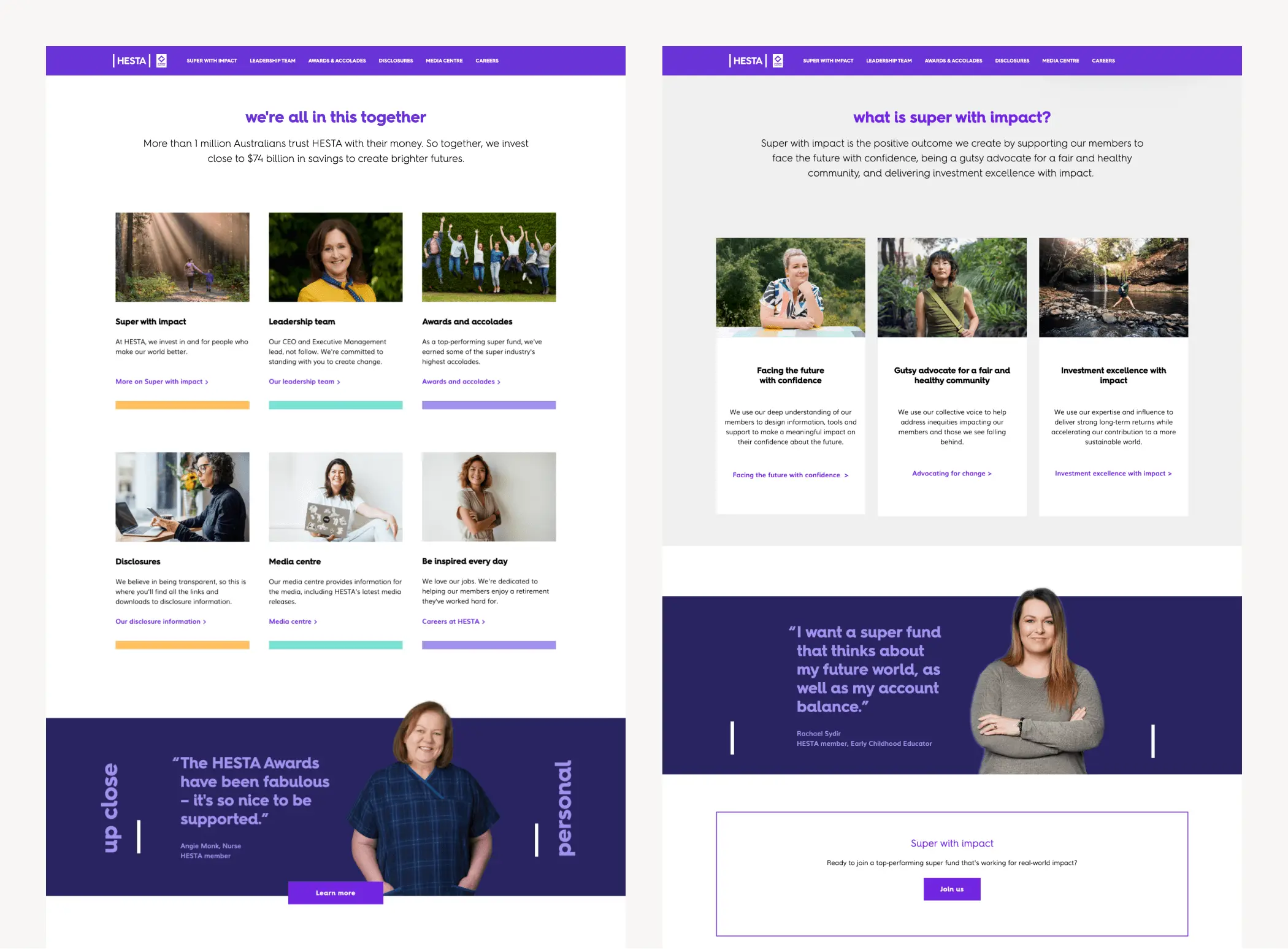
Example of a trustworthy website. Create content that includes actual customer reviews to earn visitors’ trust. (Source: HESTA)
Since face-to-face interactions are missing in online transactions, you need to find other ways to build trust between you and your visitors. Always include an ‘About’ page so that site visitors can learn more about you and what you do.
Displaying professional memberships/partnerships and site security measures is a great way to build trust for the company and any transactions on the site.
Posting past customer testimonials shows experience and a positive reputation. If selling products on the site, utilize customer reviews to reflect third-party opinions about the products and services offered.
Valuable CTAs
We’ve all seen endless junk mail and eventually canceled subscriptions from filling out forms and submitting them on sites. People are increasingly reluctant to provide their personal information, so you need to offer something in return for visitors to provide anything.
For example, you could offer a special one-time coupon or access to information and education. Providing perceived value can make visitors feel more engaged in the transaction and more likely to become long-term customers.
Also, start with forms that only require the name and email address. As marketers, you need a lot of information about leads, but asking for too much information can greatly annoy visitors.
Align Paid Ads and Website Messaging
Consistency Between Ads and Website Messaging
When visitors click on an ad and enter the website, they are likely to leave if they do not find the information or experience they want. To prevent this, the message of the ad should match the content of the website.
Ads should not just be filled with popular keywords but should consist of keywords and messages related to the website’s products or services. All elements of the website, including colors, images, ad copy, forms, etc., should convey the same message and brand identity.
If the message of the ad and the website is mixed, visitors can become confused and lose direction. This increases the likelihood of customers leaving the site or not performing the desired actions.
Therefore, to improve website conversion rates, adjust PPC and paid ad messages to align with the unique value proposition and website experience. This will help provide a consistent message and seamless experience, leading to customer conversion.
Relevant and Consistent Content
Meta tags and titles are important for SEO, but they are not the only elements that affect your site. Another critical factor in improving website conversion rates is providing valuable and consistent content.
Visitors should know what to expect when they visit the site. This includes consistent branding, valuable information, and a clear call to action.
Offer free information that educates, informs, or entertains visitors while positioning the company as an industry expert. When visitors feel that the content of the site helps them solve their pain points, they are more likely to become customers.
A clear call to action should be placed throughout the content to guide visitors to the next step, such as contacting for a quote, making a purchase, or signing up for a newsletter.
Providing Easy Checkout and Options
The checkout process should be simple and intuitive, and visitors should not experience any difficulties. Complex or cumbersome checkout processes can easily cause visitors to leave without completing their purchases. Reduce the number of steps and ensure the flow is smooth and easy to understand.
If possible, offer various payment methods. Provide as many payment options as possible to accommodate diverse customer needs and improve the likelihood of conversion.
Also, mention any shipping costs or additional fees clearly. Customers should not be surprised at the last moment during the checkout process. Provide clear information in advance to prevent losing customers due to unexpected costs.
In summary, a simple checkout process and various payment options can reduce visitor friction and increase conversion rates. Addressing these issues helps make visitors’ experiences more convenient and encourages them to complete purchases.
Benefits of Engaging Call-to-Action Buttons
Call-to-action (CTA) buttons play a crucial role in converting visitors into customers. Effective CTA buttons guide visitors to desired actions, such as purchasing, signing up for a newsletter, or downloading content. Here are some tips for effective CTA buttons:
Personalization: Tailor CTA buttons to specific visitor segments to increase relevance and effectiveness.
Clear and Concise Text: Use clear and concise text that communicates the desired action, such as “Buy Now,” “Sign Up,” or “Download.”
Compelling Design: Make the CTA button visually appealing and easily noticeable. Use contrasting colors, larger font sizes, and ample white space to make the button stand out.
Sense of Urgency: Create a sense of urgency by using phrases like “Limited Time Offer,” “Act Now,” or “Don’t Miss Out.”
Placement: Place CTA buttons strategically where visitors naturally look, such as above the fold or at the end of a blog post.
Consistency: Ensure that CTA buttons are consistent with the website’s overall design and messaging.
Conclusion
Converting visitors into customers and boosting conversion rates requires a multifaceted approach. By implementing the tips mentioned above, you can enhance your website’s performance, improve user experience, and ultimately achieve your business goals. Remember, continuous improvement and adaptation are key to staying competitive and meeting the evolving needs of your customers.
Before we dive into Growth Hacking, let’s define marketing. The term “marketing” combines “market” and “-ing,” encompassing all activities that make a market function. It’s not just about advertising and promotions for product sales.
Most business activities fall under the marketing umbrella. This includes everything from conceptualizing the product, producing prototypes, mass production, distribution, sales, promotions, to customer service (CS).
In a broad sense, marketing isn’t much different from overall business activities.
From this perspective, we can see Growth Hacking as one of many marketing methodologies.
Growth Hacking: A Marketing Methodology for Finding Minor Gaps
What is Growth Hacking?
Growth Hacking means using all possible means (Hacking) to achieve growth.
Like finding minor vulnerabilities in a target to hack, it is a marketing methodology that identifies and aggressively targets customers and distribution points for growth.
Initially, it involves hypothesizing strategies to increase brand, company, or product sales and quickly launching a Minimum Viable Product (MVP) model to get market feedback.
Based on the reactions from consumers and the market, the product or service is continuously improved until it becomes the perfect product desired by the market (customers).
During Dropboxs early stages, he spread the demo version on social media to gather initial users. Through data analysis, he found that most new users were referred by friends, leading to the ‘Friend Referral’ campaign.
This provided both the referrer and the new user with an additional 500MB of free storage, creating a viral effect among users and achieving significant marketing success.
As the term suggests, Growth Hacking maximizes efficiency and rapidly grows products and services through all means necessary for growth.
These means include data-driven analysis and market feedback to improve and expand products and services. This approach is particularly effective for startup companies with limited capital and resources.
Traditional marketing strategies focus on promotional activities to make an already complete product known to more consumers.
In contrast, Growth Hacking incorporates marketing elements throughout the entire process of producing products and services.
The first version of the product is released to the market to gather consumer feedback, which is then used to improve the product. This improved product is released again, and consumer behavior patterns are analyzed.
Repeating this process allows consumers to have increasingly satisfying purchasing experiences, which naturally leads to word-of-mouth advertising.
In other words, it analyzes buyer behavior patterns and optimizes user experience based on that analysis.
Growth Hacking involves creating products that satisfy consumer wants from production to management.
During the process of evolving into a product that perfectly matches consumer tastes, advertising effects naturally occur.
This is especially true for service improvements, which accumulate positive brand experiences, leading to high viral effects.
Hence, ‘low-cost, high-efficiency growth’ is the essence of Growth Hacking. Additionally, the continuous improvement of products and services leads to the overall growth of the company.
Growth Hacking and Growth Marketing: Methods for Securing Potential Customers
Growth Marketing
Industry professionals often use ‘Growth Marketing’ and ‘Growth Hacking’ interchangeably. Growth Marketing derives from the concept of Growth Hacking, applying it to actual marketing.
From the product conceptualization stage, it actively utilizes big data analysis to create products. Then, users are attracted through various platforms such as email, blogs, and social media, using metrics like:
CPM (Cost Per Mile: cost per thousand impressions)
CPC (Cost Per Click: cost per click)
CPL (Cost Per Lead: cost per lead, e.g., sign-ups, event participation, survey responses, comments)
CPA (Cost Per Action: cost per action, e.g., purchases, adding to cart)
Visitor numbers
These objective metrics help to continually research the companys products and understand the target audiences wants.
Insights allow to formulate new marketing strategies and continually improve the product until it meets consumer expectations, similar to Growth Hacking. Growth Marketing is a technique for securing potential customers through three stages: tracking, verification, and expansion.
Growth Hacking: Growth of Key Performance Indicators
Growth Hacker
There are professionals who specialize in analyzing these objective metrics and devising strategies to secure potential customers.
If Growth Hacking grows products and services, ‘Growth Hackers’ grow the metrics.
They meticulously investigate the markets potential elements based on KPIs (Key Performance Indicators) and remove the boundaries between service and marketing.
They work to ensure that consumers build brand experiences within the ‘service itself’ and naturally become ‘communication (marketing)’ agents to other customers.
Growth Hackers aim to create automated marketing structures within this marketing framework, where consumers themselves propagate to millions of people and sustain this propagation.
They design the foundation for continuous company and product appeal by letting consumers build and transform the ambiguous value of ‘branding.’
Applying Growth Hacking to Your Business
As discussed, Growth Hacking is a marketing methodology that identifies customer problems based on data, tests hypotheses to achieve goals, and continuously improves the product.
It doesnt necessarily require hiring a Growth Hacker or checking specific metrics. All decisions for continuous and steady growth start with data-based hypothesis formulation.
These hypotheses are verified through small experiments, leading to product improvements and sustained growth. This is the essence of Growth Hacking.
We believe that explosive growth along the so-called J-curve can be detrimental in the long run. A restaurant bustling with customers from day one may reveal issues such as food quality, service speed, and cleanliness. These problems can drive customers away once the initial excitement fades.
Therefore, we believe that planned and prepared growth to enhance customer satisfaction is more important. Growth Marketing Agency takes a marketing approach that makes time our ally.
Naver, South Koreas leading search engine, operates with distinct features and user behaviors that necessitate unique SEO strategies compared to Google. This guide provides an in-depth approach to optimizing for Naver SEO in 2024.
Naver is South Korea’s largest and most popular online platform, often referred to as “the Google of South Korea.” Launched in 1999, Naver was the first South Korean web portal to develop its own search engine. With approximately 38.8 million monthly active users as of 2023representing about 75% of the South Korean populationNaver is predominantly a Korean-language platform. This presents challenges for non-Korean speakers and highlights the importance of understanding Korean or working with local experts to effectively reach this audience.
Naver SEOs Unique Features
Naver’s Search Results Page (SERP) Layout
Naver’s SERP is notably more complex and content-rich compared to other search engines. Naver functions as a comprehensive portal where users access a wide range of services and information in one place.
In my years working in a Korean company, Ive noticed that most of my coworkers would start their day by opening Naver first thing in the morning. This daily routine involves browsing the homepage to catch up on the latest news, reading popular blog posts, and exploring trending fashion through the shopping section.
This multi-faceted functionality underscores the importance of Naver for staying informed and engaged with current trends.
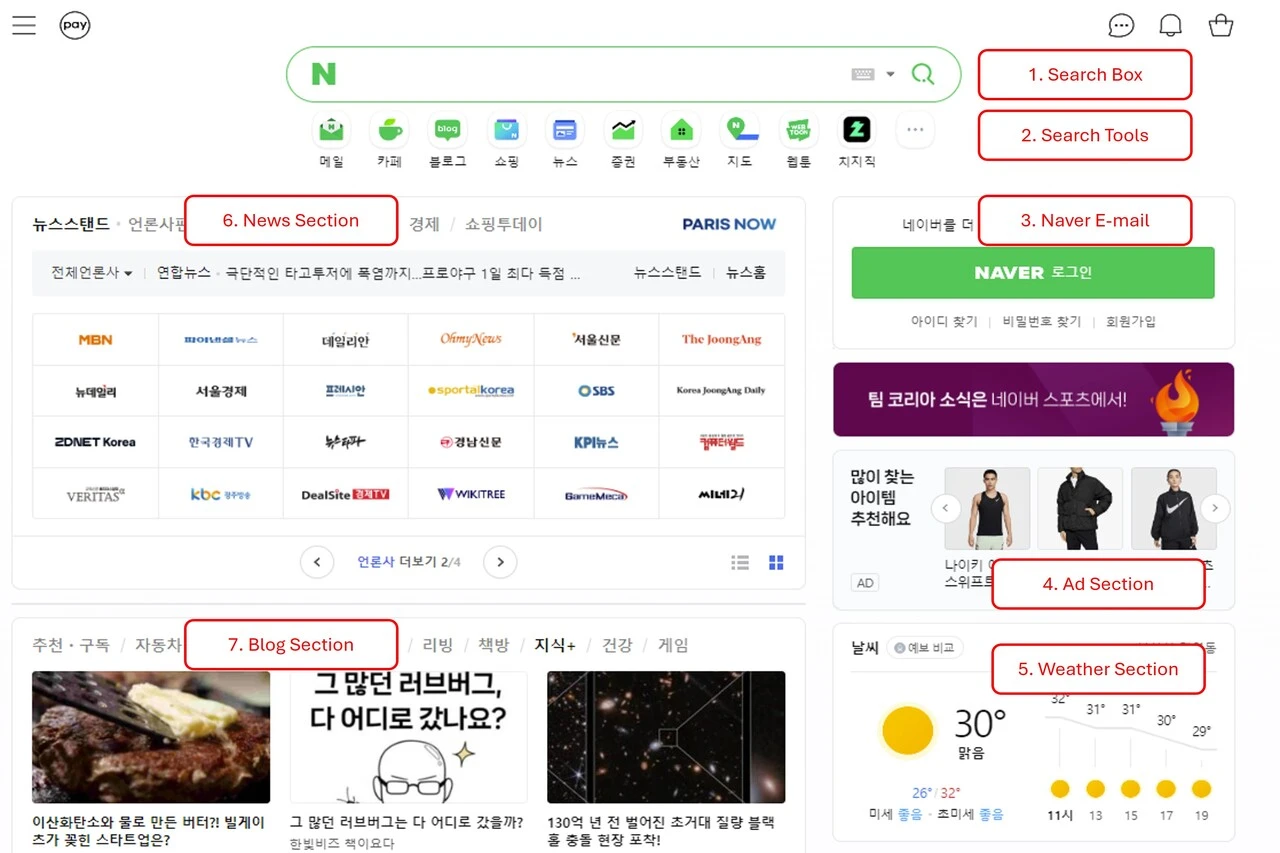
When you open Naver, the main page is structured to provide a comprehensive snapshot of information and easy navigation through its various services. It is primarily divided into the following sections:
Search Box: Allows you to input your search queries directly.
Search Tools: These buttons facilitate quick access to a variety of Naver’s services, including Mail, Cafes (similar to Reddit), Blog, Shopping, Stock Market, Map, and more.
Naver Email: Users can log in to access their Naver email accounts.
Ad Section: A designated area for paid advertisements.
Weather Section: Provides current weather updates and forecasts.
News Section: Features the latest news stories from around the country and the world.
Blogs Section: Highlights the most trending blog articles across various categories, showcasing popular and engaging content.
Naver SERP Variations by Query Type
The layout and content of Naver’s SERP can vary significantly depending on the type of query. For example:
Consumer Products (e.g., vitamin supplements)
Lets say you are a vitamin manufacturing company looking to sell your products in South Korea. Understanding the search results on Naver is crucial. Below is a breakdown of the search results for vitamin supplements on Naver (written in Korean). The first section displayed is related to Naver Shopping, emphasizing the importance of listing your products on this platform. Naver’s algorithm prioritizes the most relevant products based on public interest, recent purchases, and genuine user reviews. It’s important to note that the ‘Naver Police’ regularly monitor reviews to prevent any fraudulent activities.
Following the shopping results, the next sections include recommended items, FAQs, best-reviewed items, and organic results from company websites and blogs. This hierarchy illustrates the varied content types Naver users engage with when searching for products.
B2B Products (e.g., medical devices)
Now, consider you are a medical device manufacturer selling echocardiography machines. For potential customers, the search results predominantly feature organic results from blogs and company websites first, followed by the knowledge section, news articles, Naver Shopping listings, images, and academic journals.
As a B2B company, a strategic approach would involve ensuring your company or product is featured in news articles to achieve higher visibility in search results.
Naver SEO: Technical Optimization
Naver’s technical SEO encompasses various strategies and optimizations tailored to the specific requirements and algorithms of Naver. Unlike Google, Naver’s ecosystem includes numerous integrated services, and understanding how to navigate these is key to improving visibility.
Verify site ownership through HTML file upload, HTML tag, or DNS verification.
Site Health and Monitoring:
Regularly monitor site health using Naver Webmaster Tools.
Check for crawl errors, indexation issues, and security problems.
A UK-based vitamin supplements company has their website indexed on Naver, but their performance can be significantly improved. Upon analyzing their site using Naver Webmaster Tools, four technical issues were identified that need resolution for optimal performance and visibility on the platform. Addressing these issues will enhance their site’s search rankings and user experience on Naver.
2. Indexing and Crawling
XML Sitemap Submission:
Create and submit an XML sitemap to ensure Naver efficiently crawls and indexes your site.
Keep the sitemap updated with new or modified content.
Robots.txt File:
Use a robots.txt file to control which pages are accessible to Navers crawlers.
Ensure critical pages are not inadvertently blocked.
URL Structure:
Maintain a clean, descriptive URL structure.
Avoid dynamic URLs with complex query strings.
3. Mobile Optimization
Responsive Design:
Ensure your site uses responsive design to provide an optimal user experience across devices.
Use Naver Webmaster Tools to check mobile compatibility.
Page Speed:
Optimize site speed using tools like Google PageSpeed Insights.
Compress images, leverage browser caching, and minimize HTTP requests.
Implement relevant keywords in titles, headings, meta descriptions, and content naturally.
Meta Tags:
Write compelling meta titles and descriptions for each page.
Use accurate meta tags to help Naver understand your content contextually.
Structured Data:
Implement structured data (schema markup) to help Naver understand your content better.
Use schema for products, articles, events, and other relevant content types.
5. User Experience (UX)
Navigation and Internal Linking:
Create an intuitive navigation structure.
Use internal linking to guide users and distribute page authority.
Engagement Metrics:
Improve dwell time and reduce bounce rates by providing valuable, engaging content.
Use multimedia elements like images, videos, and interactive features.
6. Backlinks and Social Signals
Quality Backlinks:
Build high-quality backlinks from reputable Korean websites, particularly those on Naver platforms like Naver Blogs and Cafes.
Avoid spammy or low-quality link-building practices.
Social Media Integration:
Integrate social media sharing buttons to encourage content sharing.
Engage with users on Navers social platforms to boost visibility and traffic.
7. Complying with Naver Policies to Counter Black Hat SEO
Compared to Google, Naver has fewer users, search volumes, and content, making it more vulnerable to Black Hat SEO tactics that rely on generating large amounts of traffic.
To address this, Naver continually updates its search policies to counteract Black Hat SEO.
For instance, even if a significant amount of traffic is directed to a single website after searching for a specific keyword, if the sessions are not logged in with a ‘Naver ID’, this traffic is counted as zero and does not benefit the website.
By focusing on these key areas and staying attuned to the specific needs of the Korean market, businesses can significantly improve their visibility and success on Naver. Regular monitoring, adaptation to Naver’s updates, and consistent high-quality content creation are crucial for long-term success.
How Our Agency Can Help You Master Naver SEO
Navigating the intricacies of Naver SEO can be challenging, especially for businesses unfamiliar with the South Korean landscape. That’s where Growth Marketing Agency comes in. With our team of experienced Naver SEO specialists, including native Korean speakers and digital marketing experts, we can help you develop and implement a comprehensive Naver SEO strategy tailored to your specific needs.
From technical optimizations and content creation to building a strong presence on Naver’s integrated platforms, we have the expertise to boost your visibility and drive meaningful results in the South Korean market.
사업에 실패한 많은 사람들이 “고객들이 우리 제품을 몰라줘서”라는 이야기를 합니다. 하지만 고객들이 잘못해서 사업을 망치는 경우는 없습니다.
애초에 고객들이 반응할 만한 제품을 시장에 내놓지 못한 당신의 책임인 것입니다. 사업에 실패했다면, 설령 고객들의 Needs를 충족시킬 수는 있었을지 몰라도 Wants를 충족시키지는 못했기 때문입니다.
더 이상 마케팅은 단순히 키워드 광고나 블로그 활동 같은 것 만을 일컫는 단어가 아닙니다. 성장은 제품의 기획·설계부터 생산, 유통, 판매, 광고, 마케팅, A/S, C/S까지 고객의 원츠를 충족시켜 우리의 브랜드가 시장에서 소비되도록 하는 모든 경영 활동을 마케팅이라고 정의합니다.
지금 우리 브랜드, 우리 제품, 우리 서비스는 고객의 원츠를 충족하고 있나요? 혹시, 고객의 니즈를 어설프게 추측하고 내놓은 브랜드와 제품은 아닌가요? 쉽게 답을 내리기 어려우시다면, 성장의 전문가들과 함께 상의해 보시길 바랍니다.
In South Korea, YouTube has undeniably become the most widely used app based on monthly usage time. Naturally, interest and attention towards YouTube Marketing are skyrocketing.
Video marketing, in particular, boasts overwhelming effectiveness in terms of delivery compared to other static marketing strategies. It’s no wonder that companies frequently turn to this approach when promoting their products and services.
However, it’s crucial to approach YouTube marketing with caution, especially for B2B companies. Despite the booming trend, we must consider some realistic concerns.
Why aren’t there more success stories for B2B companies in this YouTube marketing frenzy? Let’s delve into the definition of YouTube marketing and explore its application to B2B companies.
What is YouTube Marketing?
Video marketing involves creating videos to promote products or services as part of content marketing. YouTube marketing specifically refers to uploading these videos to YouTube for promotional purposes.
These videos offer detailed product descriptions and user reviews, addressing the shortcomings of traditional blog or photo/text-based content.
YouTube is a platform exposed to global audiences, with minimal language barriers and easy integration with other social media channels. This allows for global marketing with brief content.
Additionally, YouTube marketing has the advantage of generating revenue through video content. For instance, paying influential YouTubers to experience and review products.
YouTube Guide for B2B Companies
So, is YouTube marketing effective for B2B companies? To answer directly, it’s unlikely.
Building a successful YouTube channel and using it for marketing is harder and slower than becoming a successful YouTuber.
The costs and time involved in producing YouTube content are substantial, and creating engaging content increases these costs further.
Despite the significant resources invested, successful cases are rare.
Although there is a possibility of success on YouTube, the likelihood is extremely low compared to the resources invested.
Some clients contact us out of curiosity after seeing references from so-called professional YouTube marketing agencies. They might start after observing famous online success cases.
However, these are merely rare success stories, and we can confidently say that 99.99% of B2B companies fail on YouTube.
Are There Successful B2B YouTube Marketing Cases?
For those skeptical about whether B2B YouTube marketing can succeed, let’s analyze B2B and G2C YouTube marketing cases.
Stone Gold’s Pet Rock
Source: SBS News
Stone Gold, a Korean company selling decorative stones, was significantly impacted by the construction industry’s downturn.
While contemplating ways to boost sales, employee Kim Myung-sung began uploading videos, which surprisingly garnered significant views.
A simple video of washing stones recorded over 9 million views, sparking interest in Stone Gold’s ‘pet rock,’ which was sold for 10,000 KRW and sold out the prepared 150 sets, reflecting its popularity. Pet rocks are ordinary rocks that are treated like pets: decorated with outfits, painted with faces, and given names and beds.
Subscribers who favored Stone Gold’s content suggested the company introduce ‘pet rocks,’ a trend at the time.
Although the ‘pet rock’ gained considerable attention, it was primarily a B2C product and a brand awareness event rather than a significant sales driver.
Analyzing the YouTube channel, despite uploading 60 pieces of content, the average views are only about 7,900.
Even with frequent, well-crafted updates, the results are disappointing. Although some interviews mentioned slight B2B sales improvement after YouTube success, it’s inappropriate to view Stone Gold’s video marketing as significantly beneficial.
In conclusion, while increasing B2C customers can improve Stone Gold’s awareness, it is not an effective method for boosting B2B product sales relative to the resources invested.
Chungju City’s YouTube Channel
Source: Chungju City’s YouTube Channel
Compared to other local government YouTube channels, Chungju City’s channel is highly successful.
The most viewed video uses the ‘Coffin Dance’ meme to promote social distancing, surpassing 500,000 views within three days.
Chungju Citys YouTube channel. Even a video uploaded three days ago has easily surpassed 500,000 views.
Despite lower quality than other government videos, it succeeded by capturing user preferences and humor points, known as B-grade marketing.
However, would company executives support such an approach for their YouTube channel?
The channel’s success was due to the bold decisions of a manager who uploaded content without higher approval during weekends.
It’s challenging to choose and maintain a B-grade concept without internal support, making B2B YouTube marketing with such concepts virtually impossible.
Why B2B YouTube Marketing is Difficult
Many are considering other marketing channels besides YouTube.
Blogs can quickly secure traffic if the posted content demonstrates expertise or covers rarely discussed topics.
Instagram, on the other hand, is a platform for showcasing lifestyle and browsing affluent individuals, making it unsuitable for B2B purposes. Global brands use Instagram to display brand identity rather than drive sales.
YouTube’s success is determined by the algorithm.
Unless you handle popular, creative, and engaging content, your chances of failure are high.
Investing time and resources in other marketing strategies may yield better results than relying on YouTube’s uncertain success.
YouTube Marketing Guide for B2B Businesses
I once bought an electronic device and read the user manual. Despite the clear illustrations, the installation was still challenging.
Suddenly, I searched for the product name on YouTube and found a video demonstrating the installation process. Although it wasnt official content from the brand, it was incredibly useful.
For B2B companies, YouTube channels can be particularly useful for showing how to use or operate products through video. Videos are far more effective at conveying information than written manuals, offering stronger delivery and higher satisfaction.
Additionally, YouTube can serve as a portfolio to showcase the company’s success stories. Videos of these achievements can be far more memorable than text or photos.
Therefore, it’s recommended to use YouTube for B2B businesses primarily to deliver necessary information conveniently.
However, it’s best not to expect high view counts, subscriber growth, or significant sales impact from YouTube.
If You Still Need YouTube Marketing
Searching for YouTube marketing on Google will reveal numerous agencies.
Unfortunately, many lack a deep understanding of ‘marketing’ despite their video expertise.
If considering YouTube marketing, ensure to work with individuals who confidently present successful B2B references (though none exist).
Consult with scriptwriters, producers, and cast with YouTube success experience, but be prepared for ambiguous responses regarding expected outcomes.
Conclusion: The B2B Marketing Landscape
Growth Marketing Agency integrates insights and expertise gained from various B2B and B2G marketing strategies to provide robust B2B marketing strategies.
We pride ourselves on the most efficient media strategies for B2B marketing.
If you’re contemplating which channels and methods to choose for B2B marketing, we recommend discussing it with Growth Marketing Agency.
Product sampling marketing is a powerful promotional strategy where businesses offer free samples of their products or services to potential customers, allowing them to experience the offering firsthand before making a purchase decision. This approach aims to increase brand awareness, stimulate interest, and ultimately drive sales by leveraging the power of direct consumer experience.
For foreign companies entering the Korean market, product sampling marketing can be an especially effective tool to gain traction and build trust with local consumers.
In today’s competitive Korean market landscape, product sampling marketing has emerged as an invaluable tool for businesses looking to gain a foothold. By providing Korean consumers with a tangible experience of their products or services, foreign companies can effectively communicate their unique value proposition and overcome cultural barriers.
As an experienced marketing expert, I’ve guided numerous foreign companies in successfully implementing product sampling campaigns in Korea. In this article, we’ll delve into the intricacies of product sampling marketing in the Korean context, exploring its benefits, challenges, and best practices to help your foreign business thrive in this dynamic market.
Understanding Product Sampling Marketing in Korea
The Power of Direct Experience in Korean Culture
Product sampling marketing resonates particularly well with Korean consumers, who often prioritize personal experience and peer recommendations in their purchasing decisions. By allowing Korean consumers to directly experience products or services and share their reviews, foreign companies can effectively showcase the strengths and appeal of their offerings while building trust with the local audience.
Navigating Cultural Nuances
While product sampling marketing is a proven effective strategy globally, its success in Korea hinges on understanding and respecting local cultural nuances. Foreign companies must be mindful of Korean consumer preferences, social norms, and communication styles to ensure their campaigns resonate with the target audience.
Establishing an Effective Budget for Product Sampling Marketing in Korea
Determining an appropriate budget for product sampling marketing in Korea requires consideration of several factors unique to the market:
1. Size and Composition of the Sampling Group
The number of participants in your sampling group directly impacts your budget. Larger groups may be necessary to gain significant traction, especially for foreign brands seeking to establish credibility.
2. Reward Value in the Korean Context
The value of gifts or services provided to participants should align with Korean expectations. Korean consumers often have high standards for product quality and presentation, which may influence the required investment in samples.
3. Type and Quantity of Products or Services Provided
Consider how your product or service fits into the Korean market. You may need to adapt your offerings to local preferences, which can impact the type and quantity of samples required.
4. Marketing Goals for the Korean Market
Your budget should align with your specific goals for the Korean market. Are you aiming to create basic awareness for your brand, or are you looking to establish a strong market presence? The latter may require a more substantial investment.
5. Market Appeal in Korea
Understand how your product or service is perceived in the Korean market. Some foreign products benefit from a “premium” image, while others may need to overcome skepticism. This perception will influence your sampling strategy and budget.
The Role of Korean Influencers in Product Sampling Marketing
Influencers play a crucial role in Korean marketing campaigns. When selecting influencers for your product sampling campaign in Korea, consider:
Follower Count: Look for Korean bloggers with significant readership, Instagrammers with large followings, or popular YouTubers. Bloggers with over 1,000 visitors, Instagrammers with over 10,000 followers, or YouTubers with over 1,000 subscribers.
Market Influence: Choose influencers relevant to your specific market and respected in Korean consumer circles.
Content Quality: Set high standards for content quality, as Korean consumers often expect polished, professional presentations.
A trusted review from a respected reviewer can have significant influence due to the importance of social proof in Korean consumer culture.
Key Steps in Product Sampling Marketing for Foreign Companies in Korea
To execute a successful product sampling marketing campaign in Korea, follow these essential steps:
Set Clear Marketing Goals for the Korean Market
Determine Sampling Group Size and Composition Based on Korean Demographics
Recruit Sampling Groups Through Korean Platforms and Networks
Select Participants Who Represent Your Target Korean Consumer Base
Provide Review Guidelines Tailored to Korean Communication Styles
Conduct Experience Activities with Sensitivity to Korean Cultural Norms
Analyze Results in the Context of the Korean Market
Common Causes of Product Sampling Failures
Understanding potential pitfalls specific to the Korean market can help you avoid them:
Misalignment with Korean Consumer Expectations
Inadequate Localization of Product or Marketing Materials
Failure to Build Relationships with Korean Influencers and Opinion Leaders
Choosing a Competent Marketing Agency in Korea
Partnering with an experienced Korean marketing agency can significantly enhance the success of your product sampling marketing campaign in Korea. Look for agencies with:
Extensive experience working with foreign companies in Korea
A proven track record of successful campaigns in the Korean market
Strong understanding of Korean consumer behavior and cultural nuances
Comprehensive services from participant selection to result analysis, tailored for the Korean market
Conclusion
Product sampling marketing, when executed correctly with an understanding of the Korean market, can significantly boost product recognition and sales for foreign companies in Korea. By carefully planning your campaign, setting clear objectives aligned with Korean consumer expectations, and partnering with a competent local agency, you can maximize the effectiveness of your product sampling efforts and achieve substantial business growth in this dynamic market.
By collaborating with Growth Marketing Agency, companies can reduce costs related to participant management and maximize marketing effectiveness. Trust in Growth Marketing Agency’s attention to detail to enhance brand awareness and conversion rates through effective product sampling marketing.
In the ever-evolving world of digital marketing, SEO translation emerges as a crucial strategy for expanding your online presence across borders.
More than just converting text from one language to another, SEO translation involves a nuanced approach to ensure that your content not only communicates effectively but also ranks high on search engines in different regions.
SEO Translation vs. Regular Translation: It’s Not Just About Words!
Picture this: Regular translation is like using Google Translate for your Tinder bio. Sure, it gets the basic message across, but will it make someone swipe right? Probably not. SEO translation, on the other hand, is like having a savvy local friend rewrite your bio to make you irresistible in a new city. See the difference?
What Sets SEO Translation Apart:
Keyword Magic: We don’t just translate; we transform. We dig deep to find those juicy keywords that’ll make search engines in your target market sit up and take notice.
Cultural Finesse: Remember that time Joey from Friends tried to speak French? Yeah, we avoid that level of cultural confusion. We make sure your content resonates locally, no matter where it lands.
Search Engine Charm: Each search engine has its quirks. Google might be into long-tail keywords, while Naver in Korea might prefer its content short and sweet. We speak all these languages fluently!
Structure Makeover: We don’t just translate your content; we give it a full SEO makeover, from headers to meta descriptions.
The Impact: Because Who Doesn’t Love a Good Success Story?
Now, I could throw a bunch of impressive-sounding statistics at you, but let’s be real – those can be as made up as my chances of ever enjoying Cheonggukjang (sorry, Korea, I tried!). Instead, let me share a real story from our agency’s treasure trove of experiences.
A Tale of EdTech Transformation
We recently worked with an EdTech client who wanted to take their Korean content global. Their previous translations? Let’s just say they were about as effective as using a flip phone in the age of smartphones.
The problem? Their translators were treating Korean-to-English translation like a word-for-word marathon.Languages are like fashion trends. What’s chic in Korean could be a major faux pas in English.
For example, we found titles like “???? ??? ??? ?? ??? ??” translated to “The best method for effective online learning”. Not terrible, but about as SEO-friendly as a cat video is to dog lovers.
Our approach? We put on our SEO dancing shoes and:
Restructured titles to front-load keywords: “Online Learning: Top Strategies for Effectiveness”
Dug deep into keyword research (nerd alert: we love this stuff!)
Sprinkled in related terms like “e-learning hacks” and “digital study tips”
The result? Their English blog traffic shot up faster than my caffeine levels on a Monday morning. We’re talking a serious boost in organic traffic, better search rankings, and more social shares than a cute puppy video.
Want to Join the SEO Translation Party?
Listen, in today’s digital world, it’s not enough to just speak the language. You’ve got to speak the language of search engines AND international audiences. It’s like being fluent in human and robot at the same time – and yes, it’s as cool as it sounds.
So, are you ready to take your website from “lost in translation” to “found in every nation”? Here at Growth Marketing, we’re not just translators; we’re your global SEO sidekicks, ready to help you conquer the digital world, one keyword at a time.
Contact us and let’s chat about turning your website into a multilingual, traffic-attracting, conversion-generating superhero. In the immortal words of every travel influencer ever, ‘The world is waiting!’ (Just make sure it can find you online first!
In today’s interconnected world, International SEO is your website’s ticket to reaching audiences across borders, languages, and cultures. It transforms your local online presence into a global phenomenon.
More than just translating content, International SEO involves creating a seamless, localized experience for users worldwide. When executed correctly, it’s a game-changer for your digital strategy.
Why International SEO Matters
International SEO is the secret sauce that can turn your website from a local diner into a global franchise. It is your ticket to reaching audiences across borders, languages, and cultures. It’s not just about translating your content (though that’s part of it). It’s about creating a seamless, localized experience for users worldwide.
Best Practices for International SEO
1. Embrace the Power of hreflang Tags
First things first, let’s talk about hreflang tags. These little bits of code are like magical signposts for Google, telling it which version of your site to show to users based on their language and location.
2. Choose Your Domain Structure Wisely
When it comes to international SEO, your domain structure is like choosing the right outfit for a global party. You’ve got three main options:
Each has its pros and cons, but here’s a pro tip: ccTLDs are great for local credibility, but they’re high-maintenance. Subdirectories are easier to manage and can still rank well with proper optimization.
3. Localize, Don’t Just Translate
Here’s where things get interesting. Proper localization goes beyond word-for-word translation. It’s about adapting your message to resonate with local cultures, customs, and expressions.
For example, while working with a major Korean company, we discovered they were using the keyword “Ultrasound System” throughout their English site. Plot twist: their global audience was searching for “Ultrasound Machine.” It’s like offering sauerkraut to someone asking for kimchi – similar, but not quite right!
This seemingly small detail made a huge difference in their search visibility. By aligning their content with local search terms, we saw a huge increase in organic traffic for those key product pages.
The Importance of Keywords Search in International SEO
Tools like Ahrefs, SEMrush, and Ubbersuggest are your best friends here. They offer country-specific keyword data, letting you peek into the search habits of your international audience.
But here’s the kicker these tools are powerful, but they’re not magic wands. You need to know how to interpret the data and apply it to your strategy. That’s where working with a specialized marketing agency can make all the difference.
4. Speed It Up, Across the Globe
Website speed is like a good cup of coffee it should be quick, smooth, and satisfying no matter where you are in the world. And the data backs this up: 83% of online users expect websites to load in 3 seconds or less, and a staggering 40% will abandon a website that takes longer than 3 seconds to load. These numbers underscore just how critical speed is to your global SEO strategy.
Consider using a Content Delivery Network (CDN) to serve your content from servers closer to your international users. Because nobody likes waiting for a webpage to load. It’s like waiting for your crush to text back painful and unnecessary. And now we know it’s not just painful it’s potentially costing you 40% of your potential visitors!
The Power of Local Expertise
While tools provide data, nothing beats local expertise. At Growth Marketing, we’ve seen firsthand how collaborating with local SEO specialists can uncover golden opportunities that data alone might miss.
For instance, when helping an international company expand into the Korean market, we discovered that their main competitor was dominating a set of long-tail keywords our client hadn’t even considered. By tapping into this local insight, we were able to carve out a niche and boost our client’s visibility in a highly competitive market.
Ready to Go Global?
Implementing these international SEO best practices is like giving your website a passport and a plane ticket. You’re setting it up for an exciting journey across the digital globe. Remember, it’s not a one-and-done deal. Like any good traveler, your website needs to adapt and evolve as it explores new territories.
So, are you ready to take your website on a world tour? With these international SEO strategies in your toolkit, you’re well on your way to global digital domination.
And if you’re feeling a bit overwhelmed by all this don’t worry! That’s where agencies like Growth Marketing come in. We eat, sleep, and breathe international SEO (in multiple languages, no less). We can help you navigate the complexities of global markets, from keyword research to cultural nuances and everything in between.