[태그:] Naver SEO

  • Korean SEO Tip: Why You Should Avoid Korean URLs

    Korean SEO Tip: Why You Should Avoid Korean URLs

    As the allure of the Korean market grows, many foreign companies are making their move. But in this process, one crucial element often gets overlooked: SEO. Why is it so important?

    Korea is an internet powerhouse. Most consumers rely heavily on online searches when making purchasing or investment decisions. Therefore, ranking high in search results directly impacts revenue. This is where SEO plays a pivotal role.

    However, many foreign companies set their Korean SEO strategies without fully understanding the nuances of the Korean market, leading to mistakes. 

    One of the common Korean SEO mistakes that foreign companies make when entering the Korean market is using Korean URLs. We’ll focus on this misconception and explore more effective Korean SEO strategies.

    Korean SEO mistake: The use of Korean URLs

    Foreign companies often think, “We’re targeting the Korean market, so Korean URLs must be good, right?” Unfortunately, this is a significant misconception.

    Why are Korean URLs problematic?

    • URL Breakage: Korean URLs are converted to Punycode, an encoding system that represents Unicode characters in ASCII, when used in the domain name system. For example, ‘??.kr’ becomes ‘xn--vg1bl39d.kr’. While this encoding allows Korean characters to be used in URLs, it can impact user experience by making the URLs less readable and recognizable, potentially causing confusion when shared.
    Korean SEO Example
    Source: ?? ??? ??? ? SEO? ??? ????
    • Browser Compatibility: Some browsers may not properly recognize Korean URLs, potentially losing potential customers.
    • Search Engine Crawling Issues: Search engine bots may struggle to crawl Korean URLs, negatively impacting search result visibility.

    The Advantages of English URLs when working on Korean SEO

    So, why are English URLs a better choice?

    • Stable Compatibility: English URLs work reliably across all browsers and systems.
    • Global Accessibility: Even when targeting the Korean market, it’s wise to consider global accessibility. English URLs make this possible.
    • SEO-Friendly: Search engines can more easily understand and index English URLs, benefiting your overall Korean SEO efforts.?

    Effective Korean SEO Strategies

    Now, what should you do? Here are some effective Korean SEO strategies for the Korean market:

    1. Combine English URLs with Korean Keywords: Keep your URLs in English, but strategically place Korean keywords within your page content. For example, use this URL structure: www.yourcompany.com/whitening-cream, while including Korean keywords like “?? ??” in your page content.
    2. Optimize Metadata: Write your title tags and meta descriptions in Korean. These are crucial as they appear in search results.
    3. Localize Content: Simply translating English content isn’t enough. Understand Korean culture and business practices, and reflect these in your content.
    4. Optimize for Korean Search Engines: Don’t just focus on Google. Optimize for major Korean search engines like Naver and Daum.
    5. Mobile Optimization: Korea has an extremely high mobile usage rate. Therefore, mobile-friendly website design and content structure are essential for successful Korean SEO.

    Other SEO Mistakes to Avoid

    Besides using Korean URLs, there are other Korean SEO mistakes that foreign companies often make. It’s crucial to avoid these as well.

    1. Keyword Stuffing: Cramming in keywords doesn’t help SEO. It can even be considered spam. Use keywords naturally.
    2. Low-Quality Content: Content that’s high in quantity but low in quality doesn’t help. Create high-quality content that provides real value to users.
    3. Ignoring Page Speed: Page loading speed is a crucial SEO factor. Improve page speed through image optimization, caching, and other techniques.
    4. Neglecting Meta Tags: Title tags and meta descriptions are SEO basics. Write unique and descriptive meta tags for each page.

    Real-World Application: The Nike Korea Example

    Let’s take a real-world example to illustrate the impact of using Korean URLs in Korean SEO. Nike, a global brand, has a dedicated Korean website. While they are a leader in digital marketing, even they aren’t immune to the pitfalls of Korean URLs.

    Consider this product URL from Nike Korea:

    Korean SEO: Nike Example

    Original URL: ??-??-???-?-??-???-6P0mijB1/FZ3503-100

    When copied, this URL appears as:

    Encoded URL: https://www.nike.com/kr/t/%EC%8A%AC%EB%9E%A8-%EC%97%AC%EC%84%B1-%EB%93%9C%EB%9D%BC%EC%9D%B4-%ED%95%8F-%EB%B0%98%ED%8C%94-%ED%8B%B0%EC%85%94%EC%B8%A0-6P0mijB1/FZ3503-100

    This encoding has far-reaching implications beyond mere URL breakage:

    • User Experience Impact: When users see such an encoded URL, it can create confusion and frustration. The URL becomes nearly impossible to remember or manually type, leading to a poor user experience that can drive customers away.
    • Brand Perception: These complex URLs can inadvertently communicate a lack of attention to local user needs.?
    • SEO Complications: While the technical aspects of SEO, such as search engine crawling, are important, the broader SEO implications for global brands are even more critical. Korean consumers expect a seamless digital experience. When they encounter issues with sharing or accessing content due to complex URLs, it can reduce engagement and, ultimately, the effectiveness of the brand?s online presence in Korea.

    Optimized Korean SEO Strategy for Nike Korea

    Instead of using Korean characters in URLs, Nike could improve their Korean SEO by adopting English URLs combined with Korean keywords within the page content. For example:

    • Optimized URL: `https://www.nike.com/kr/t/slam-womens-dri-fit-short-sleeve-t-shirt/FZ3503-100`
    • Page Content: Include Korean keywords such as “?? ?? ??? ? ?? ???” within the product description and metadata.

    This approach would make the URL more user-friendly, easier to share, and more compatible across different browsers and platforms, all while maintaining strong Korean SEO performance.

    Conclusion: SEO is an Ongoing Process

    As the Nike Korea example shows, even top brands can fall into the trap of using Korean URLs, which can hinder their Korean SEO efforts. By opting for English URLs and strategically incorporating Korean keywords within content, companies can enhance user experience and improve their search engine rankings.

    Remember, Korean SEO isn’t a one-time task. Continuous monitoring and improvement are necessary to stay ahead of the competition in the ever-changing digital landscape. With the right strategy, you can achieve significant success in the Korean market.

    At Growth Marketing Agency, we have decades of experience working in SEO across diverse markets. In our experience, pages with Korean URLs have consistently underperformed, often leading to issues in user engagement and search engine visibility. We’ve seen firsthand how adopting English URLs and incorporating localized content can dramatically improve results.

  • Naver SEO Strategies: Naver’s Personalized Search

    Naver SEO Strategies: Naver’s Personalized Search

    Have you ever felt that the search results on Naver vary slightly each time you search? If so, you’ve already experienced Naver’s personalized search!

    According to a 2020 article by Naver, personalized search has been an integral part of their strategy for some time now.

    Naver SEO strategies aren’t just about improving the user experienceit represents a significant change for digital marketing strategies. Understanding these dynamics can help marketers adapt and thrive in this evolving landscape.

    In this article, we will delve deep into Naver SEO strategies, especially the personalized search, and discuss how they impact our marketing strategies and how we should respond.

    Introduction to Naver’s Personalized Search

    Why did Naver introduce personalized search? The main reason is to enhance user satisfaction. Naver has constantly strived to help users find the information they want faster and more accurately. However, one challenge remained: every user’s search intent is different. 

    For example, when searching for K-pop star “IU,” some might look for the latest album information, while others might seek details about her upcoming drama. To meet these diverse needs, Naver introduced personalized search.

    Naver’s Efforts to Improve User Satisfaction

    Naver SEO strategies include content diversification, user pattern analysis, and real-time optimization.

    • Content Diversification: Provides various types of content such as movies, webtoons, and news for the same search term.
    • User Pattern Analysis: Analyzes individual search and click histories to understand preferred content types.
    • Real-time Optimization: Adjusts search results in real-time based on user behavior.

    These efforts ultimately aim to help users find the information they want more easily and quickly. For marketers like us, this is significant because it provides an opportunity for our content to reach the right target more accurately!

    Naver SEO Strategies: Personalized Search Implementation

    Now, let’s take a closer look at how Naver implements personalized search.

    Personalization of Content Information

    Naver’s first strategy is the personalization of content information, which provides various types of content according to user preferences.

    For example, when searching for “True Beauty (????)”:

    • Users who frequently watch K-dramas are presented with detailed information about the TV show, including the latest episodes, cast details, and viewer ratings.
    • Users who enjoy webtoons are shown information about the “True Beauty” webtoon series, such as chapter summaries, artwork, and recommendations for other similar webtoons.
    Naver SEO Strategies: Personalized Search
    Comparison of Standard vs. Personalized Search Results Using the Example of “True Beauty”

    To achieve this, Naver conducts user pattern analysis using statistical methods, specifically employing the Hellinger Distance statistical technique to understand users’ content consumption patterns and provide appropriate search results.

    ?Marketing Insight: This suggests that we marketers need to create various types of content. Producing content in diverse formats, such as blog posts, infographics, and videos on a single topic, increases the likelihood of exposure to more users.

    Personalization of Collection Rankings

    Naver’s second strategy is the personalization of collection rankings, which involves displaying preferred document types (e.g., images, videos, news) at the top of search results.

    For instance:

    • Users who often click on news are shown news collections at the top.
    • Users who frequently view images are shown image collections at the top.

    Naver also uses statistical methods to analyze user patterns, comparing them with other users to determine which type of collection a specific user prefers and reflecting this in the search results.

    Naver Collections

    ?Marketing Insight: This highlights the importance of understanding the preferred content format of our target audience. For example, if targeting a younger demographic, focusing on video content, while targeting professionals may require more detailed text-based content.

    Future Development Directions

    Naver is continuously developing its personalized search. Notably, it is working on a new content and channel recommendation system that reflects users’ tastes and interests. This signifies a shift towards actively recommending new information that users might be interested in, beyond merely personalizing search results.

    ?Marketing Insight: This emphasizes the importance of content marketing. Beyond creating keyword-optimized content, we must accurately understand our target audience’s interests and needs and consistently produce high-quality content that meets those needs.

    Impact on Marketing Strategies

    Let’s now explore in detail how these changes in Naver SEO strategies affect our marketing strategies.

    Content Optimization

    Naver’s personalized search demands significant changes to our content strategy.

    Necessity of Creating Various Forms of Content

    We now need to create diverse forms of content on a single topic. For example, if marketing under the theme “healthy diet”:

    • Blog Post: “10 Tips for Effective Dieting”
    • Infographic: “Meal Plans to Boost Diet Success Rates”
    • Video: “5-Minute Diet Exercise Routine”
    • News Article: “Scientific Basis of Dieting Revealed by Latest Research”

    By producing content in various formats, we can reach different user groups who prefer text, visual information, or videos.

    Selecting Content Types Suitable for Target Audience

    At the same time, we must focus on the content types preferred by our main target audience. For example:

    • For targeting 10-20 year-olds: short, fun videos, infographics, etc.
    • For targeting 30-40 year-old professionals: in-depth blog posts, expert interviews, etc.
    • For targeting those over 50: easy-to-read news-style content, large font infographics, etc.

    We should develop a content strategy that considers the characteristics and preferences of our target audience.

    Explore Growth Marketing Agencys Content Marketing Case Study

    Changes in Naver SEO Strategies

    Naver’s personalized search also requires significant changes to the existing Naver SEO strategies.

    Diversification of Keyword Strategy

    It is no longer enough to focus solely on popular keywords. Instead, the following approaches are necessary:

    • Utilizing Long-tail Keywords: Use more specific and segmented keywords. For example, instead of the general keyword “diet,” use more specific keywords like “low-carb diet for 30-year-old professionals.”
    • Semantic Keyword Grouping: Group related keywords semantically to compose content. For example, group “diet,” “weight loss,” “calorie restriction,” and “healthy diet” together to create comprehensive content.

    Optimization Based on User Intent

    Focus on user search intent rather than the keywords themselves. For example:

    • Informational Search: Provide detailed guides answering questions like “What are the principles of dieting?”
    • Transactional Search: For keywords like “buy diet food,” provide product comparison information or purchase guides.
    • Navigational Search: Directly link to official websites or product pages for brand names or specific product searches.

    Increased Importance of Technical SEO

    Naver will use more complex algorithms to provide personalized search results. Therefore, the following technical SEO elements become more important:

    • Structured Data Markup: Use Schema.org, etc., to clearly convey the meaning and structure of the content.
    • Mobile Optimization: Ensure mobile-friendly design and fast loading speed.
    • Site Structure Optimization: Build a clear and logical URL structure and internal linking system.

    Importance of Analyzing User Behavior

    Naver’s personalized search operates based on user behavior data. Therefore, we need to analyze and understand user behavior more precisely.

    Analysis of Customer Search Patterns and Preferences

    We need to collect and analyze the following data:

    • Key Inflow Keywords
    • On-site Search Terms
    • Page Dwell Time
    • Click Path
    • Engagement by Content Type (e.g., text vs. video)

    Developing Data-Driven Marketing Strategies

    Based on the collected data, we can develop the following strategies:

    • Creating Customized Content for Customer Segments
    • Identifying and Focusing on the Most Effective Content Types
    • Optimizing User Journey
    • Establishing Retargeting Strategies

    Conclusion

    In conclusion, Naver’s personalized search is a significant change that requires us to rethink and adapt our marketing strategies. By understanding and responding effectively to these changes, we can ensure that our content reaches the right target audience and achieves the desired results.

    At Growth Marketing Agency, we have extensive experience in navigating Navers content ecosystem. Our team is well-versed in crafting strategies that can help your business effectively reach and engage its target audience. By leveraging our expertise, you can turn these changes into opportunities and stay ahead of the competition. Embracing Naver SEO strategies can help your business stay competitive in this dynamic digital landscape.

  • Naver SEO: What is Naver and How to Improve Your Rankings

    Naver SEO: What is Naver and How to Improve Your Rankings

    Naver, South Koreas leading search engine, operates with distinct features and user behaviors that necessitate unique SEO strategies compared to Google. This guide provides an in-depth approach to optimizing for Naver SEO in 2024.

    South Koreas Search Engine Market Share (2024)
    South Koreas Search Engine Market Share

    What is Naver?

    Naver is South Korea’s largest and most popular online platform, often referred to as “the Google of South Korea.” Launched in 1999, Naver was the first South Korean web portal to develop its own search engine. With approximately 38.8 million monthly active users as of 2023representing about 75% of the South Korean populationNaver is predominantly a Korean-language platform. This presents challenges for non-Korean speakers and highlights the importance of understanding Korean or working with local experts to effectively reach this audience.

    Naver SEOs Unique Features

    Naver’s Search Results Page (SERP) Layout

    Naver’s SERP is notably more complex and content-rich compared to other search engines. Naver functions as a comprehensive portal where users access a wide range of services and information in one place. 

    In my years working in a Korean company, Ive noticed that most of my coworkers would start their day by opening Naver first thing in the morning. This daily routine involves browsing the homepage to catch up on the latest news, reading popular blog posts, and exploring trending fashion through the shopping section. 

    This multi-faceted functionality underscores the importance of Naver for staying informed and engaged with current trends.

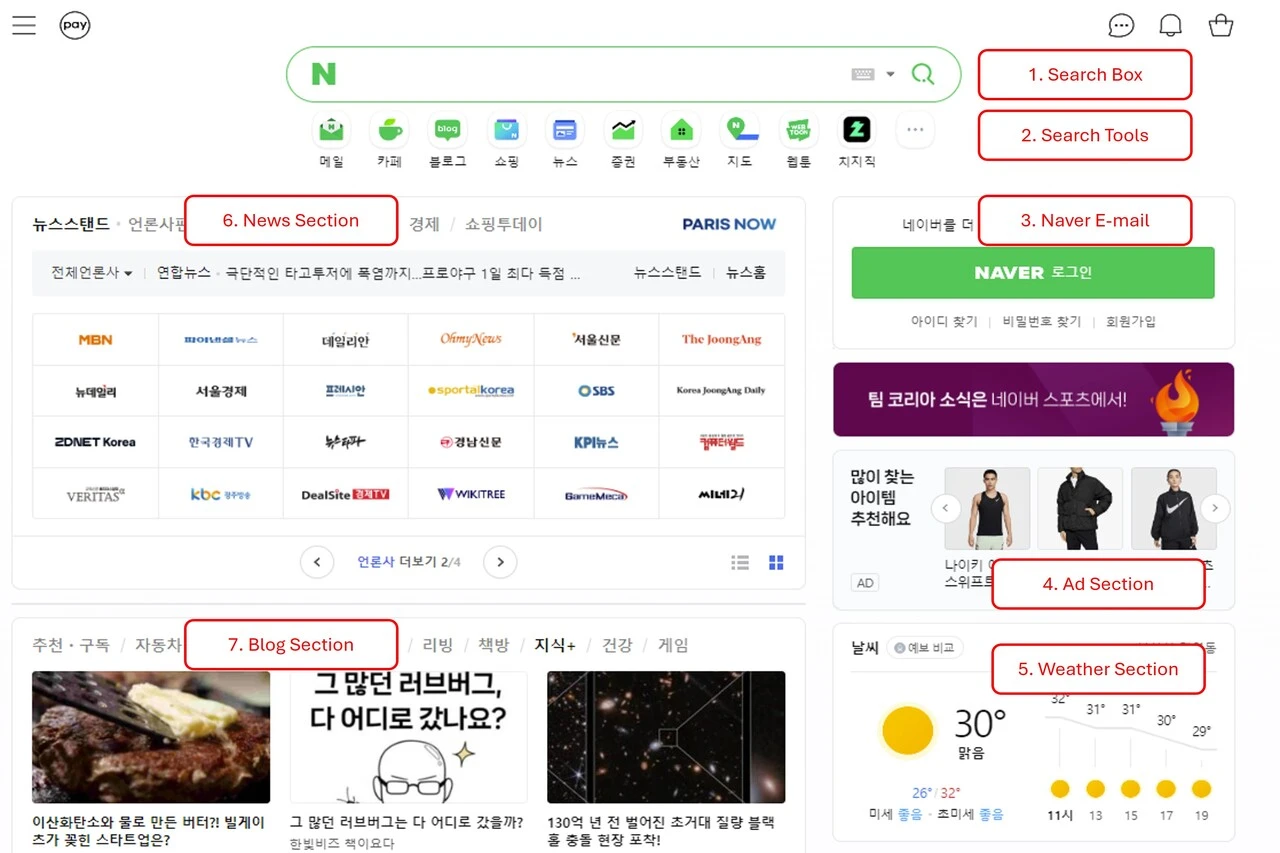
    Naver Search Layout

    When you open Naver, the main page is structured to provide a comprehensive snapshot of information and easy navigation through its various services. It is primarily divided into the following sections:

    1. Search Box: Allows you to input your search queries directly.
    2. Search Tools: These buttons facilitate quick access to a variety of Naver’s services, including Mail, Cafes (similar to Reddit), Blog, Shopping, Stock Market, Map, and more.
    3. Naver Email: Users can log in to access their Naver email accounts.
    4. Ad Section: A designated area for paid advertisements.
    5. Weather Section: Provides current weather updates and forecasts.
    6. News Section: Features the latest news stories from around the country and the world.
    7. Blogs Section: Highlights the most trending blog articles across various categories, showcasing popular and engaging content.

    Naver SERP Variations by Query Type

    The layout and content of Naver’s SERP can vary significantly depending on the type of query. For example:

    Consumer Products (e.g., vitamin supplements)

    Lets say you are a vitamin manufacturing company looking to sell your products in South Korea. Understanding the search results on Naver is crucial. Below is a breakdown of the search results for vitamin supplements on Naver (written in Korean). The first section displayed is related to Naver Shopping, emphasizing the importance of listing your products on this platform. Naver’s algorithm prioritizes the most relevant products based on public interest, recent purchases, and genuine user reviews. It’s important to note that the ‘Naver Police’ regularly monitor reviews to prevent any fraudulent activities.

    Naver SERP Variations by Query Type for B2C

    Following the shopping results, the next sections include recommended items, FAQs, best-reviewed items, and organic results from company websites and blogs. This hierarchy illustrates the varied content types Naver users engage with when searching for products.

    B2B Products (e.g., medical devices)

    Now, consider you are a medical device manufacturer selling echocardiography machines. For potential customers, the search results predominantly feature organic results from blogs and company websites first, followed by the knowledge section, news articles, Naver Shopping listings, images, and academic journals. 

    Naver SERP Variations by Query Type for B2C

    As a B2B company, a strategic approach would involve ensuring your company or product is featured in news articles to achieve higher visibility in search results.

    Naver SEO: Technical Optimization

    Naver’s technical SEO encompasses various strategies and optimizations tailored to the specific requirements and algorithms of Naver. Unlike Google, Naver’s ecosystem includes numerous integrated services, and understanding how to navigate these is key to improving visibility. 

    1. Naver Webmaster Tools

    Account Setup and Verification:

    • Create a Naver account and register your site with Naver Webmaster Tools.
    • Verify site ownership through HTML file upload, HTML tag, or DNS verification.

    Site Health and Monitoring:

    • Regularly monitor site health using Naver Webmaster Tools.
    • Check for crawl errors, indexation issues, and security problems.
    Naver SEO: Naver Webmaster Tools

    A UK-based vitamin supplements company has their website indexed on Naver, but their performance can be significantly improved. Upon analyzing their site using Naver Webmaster Tools, four technical issues were identified that need resolution for optimal performance and visibility on the platform. Addressing these issues will enhance their site’s search rankings and user experience on Naver.

    2. Indexing and Crawling

    XML Sitemap Submission:

    • Create and submit an XML sitemap to ensure Naver efficiently crawls and indexes your site.
    • Keep the sitemap updated with new or modified content.

    Robots.txt File:

    • Use a robots.txt file to control which pages are accessible to Navers crawlers.
    • Ensure critical pages are not inadvertently blocked.

    URL Structure:

    • Maintain a clean, descriptive URL structure.
    • Avoid dynamic URLs with complex query strings.

    3. Mobile Optimization

    Responsive Design:

    • Ensure your site uses responsive design to provide an optimal user experience across devices.
    • Use Naver Webmaster Tools to check mobile compatibility.

    Page Speed:

    • Optimize site speed using tools like Google PageSpeed Insights.
    • Compress images, leverage browser caching, and minimize HTTP requests.

    4. Content Optimization

    Keyword Research and Implementation:

    • Conduct keyword research using Navers keyword tools and trends.
    • Implement relevant keywords in titles, headings, meta descriptions, and content naturally.

    Meta Tags:

    • Write compelling meta titles and descriptions for each page.
    • Use accurate meta tags to help Naver understand your content contextually.

    Structured Data:

    • Implement structured data (schema markup) to help Naver understand your content better.
    • Use schema for products, articles, events, and other relevant content types.

    5. User Experience (UX)

    Navigation and Internal Linking:

    • Create an intuitive navigation structure.
    • Use internal linking to guide users and distribute page authority.

    Engagement Metrics:

    • Improve dwell time and reduce bounce rates by providing valuable, engaging content.
    • Use multimedia elements like images, videos, and interactive features.

    6. Backlinks and Social Signals

    Quality Backlinks:

    • Build high-quality backlinks from reputable Korean websites, particularly those on Naver platforms like Naver Blogs and Cafes.
    • Avoid spammy or low-quality link-building practices.

    Social Media Integration:

    • Integrate social media sharing buttons to encourage content sharing.
    • Engage with users on Navers social platforms to boost visibility and traffic.

    7. Complying with Naver Policies to Counter Black Hat SEO

    •  Compared to Google, Naver has fewer users, search volumes, and content, making it more vulnerable to Black Hat SEO tactics that rely on generating large amounts of traffic.
    • To address this, Naver continually updates its search policies to counteract Black Hat SEO. 
    • For instance, even if a significant amount of traffic is directed to a single website after searching for a specific keyword, if the sessions are not logged in with a ‘Naver ID’, this traffic is counted as zero and does not benefit the website. 

    By focusing on these key areas and staying attuned to the specific needs of the Korean market, businesses can significantly improve their visibility and success on Naver. Regular monitoring, adaptation to Naver’s updates, and consistent high-quality content creation are crucial for long-term success.

    How Our Agency Can Help You Master Naver SEO

    Navigating the intricacies of Naver SEO can be challenging, especially for businesses unfamiliar with the South Korean landscape. That’s where Growth Marketing Agency comes in. With our team of experienced Naver SEO specialists, including native Korean speakers and digital marketing experts, we can help you develop and implement a comprehensive Naver SEO strategy tailored to your specific needs. 

    From technical optimizations and content creation to building a strong presence on Naver’s integrated platforms, we have the expertise to boost your visibility and drive meaningful results in the South Korean market.