Why should we examine B2B startup failure cases, especially those that failed? The reason is that B2B startups operate in a highly competitive environment, where many companies experience failure. Often, these companies attribute their failure to their products not achieving market fit. In other words, they created products that no one wanted, leading to an inability to gain customers and generate revenue. However, they often miss the underlying issues at play.
Let’s take a closer look at the B2B startup failure case of Argyle Social to understand the barriers in the B2B startup market and uncover the key lessons from this marketing case.
B2B Startup Failure Case: Why Did Argyle Social Fail?
Who is Argyle Social?

Argyle Social was a company that provided a social marketing platform. It offered an interactive platform designed to help marketers improve customer engagement and lead generation on social media platforms.
Initially, the platform was well-received, recognized for its reasonable pricing in the market. At one point, it even became a preferred program among marketers due to its intuitive dashboard and effective scheduling features.
Why Argyle Social Failed?
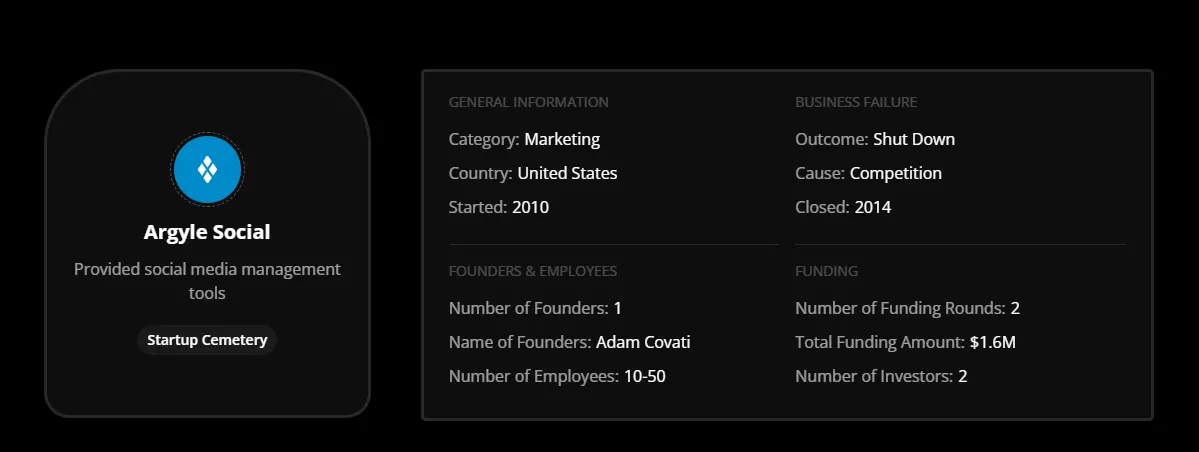
However, despite its early success, Argyle Social eventually closed its doors.
The company’s founder, Adam Covati, made efforts to integrate their software with various social media marketing automation tools to stand out from the competition.
Although these efforts were practically useful for marketing, the company lost momentum in the market due to the aggressive marketing strategies of its competitors.
This B2B startup failure case highlights the risks associated with underestimating the power of marketing in a highly competitive landscape.
As Argyle Social became less competitive, its financial situation deteriorated to the point where it struggled to pay its employees, let alone fund the development and launch of new software.
Social media giants like Facebook and Twitter frequently updated their APIs, and Argyle Social needed to keep up with these changes to function effectively on these platforms.
While the company had the talent and technology, it lacked the manpower and funding to manage these updates. The shortage of funds led to a lack of personnel, making it impossible to maintain sufficient service levels.
Covati sought business partners, but no one was willing to invest in Argyle Social’s potential, making it a cautionary B2B startup failure case.
B2B Startups: The Importance of Marketing
Many B2B startups face crises when they fail to secure additional funding before stabilizing their operations.
Most startups find themselves in an intensely competitive environment and eventually realize they are not growing fast enough to generate the necessary revenue due to limited funds.
Argyle Social is a prime B2B startup failure case, having experienced explosive growth in its early stages but ultimately failing to sustain it.
The Downfall of Argyle Social: Neglecting Marketing
Over its four years of operation, approximately 500 companies used Argyle Social’s platform. Despite achieving a reasonable profit at a mid-market price point, Covati admitted that competing with large companies was an uphill battle.
As automation in social marketing platforms became a hot topic, Argyle Social garnered significant attention, but the competition became fiercer as more companies entered the field.
In the end, Covati conceded that they lost the fight against larger competitors. This B2B startup failure case serves as a reminder of the consequences of neglecting marketing efforts.
Covati’s Reflection on Failure

According to Adam Covati, the CEO of Argyle Social, “Interest from suppliers and knowledgeable customers was high, and with our intriguing integrations and technology, Argyle Social seemed promising. However, business partners believed that while our technology was interesting, it was still premature.”
He added that there was one thing he deeply regretteda critical point that could have influenced the company’s future and possibly helped them avoid failure. “Since our customers became direct marketing channels, we didn’t invest in our own marketing. The common issue for tech-based companies like ours is that we fail to recognize the importance of marketing. We didn’t realize that good technology and resources alone were not enough. Argyle Social initially invested in marketing, but in hindsight, we should have continued to invest boldly in our own marketing. However, such decisions are difficult to make when managing finances.”
Covati hoped that other B2B startups would not follow in their footsteps. He stressed that while it may be difficult for CEOs to decide where to invest their capital, skimping on self-marketing is a foolish move. Despite attracting a substantial number of customers in its early stages, Argyle Social eventually lost them to competitors who could outpace them with large-scale marketing strategies. Their financial resources were simply insufficient to compete with the extensive marketing efforts of their rivals.
Lessons from B2B Startup Marketing Cases
Invest in Your Own Marketing

Covati pointed out that it is challenging for small startups to keep up with platforms like Facebook and Twitter.
Over time, it becomes increasingly difficult to maintain competitiveness with certain services from other companies.
Every time social networks update their APIs, substantial development work is required on third-party social media platforms as well. Argyle Social attempted to automate and cut back on self-marketing to invest more in these technological developments.
However, their efforts to integrate marketing automation systems ultimately failed to yield results.
Meanwhile, their competitors secured significant capital and expanded their sales and marketing strategies, leading to yet another B2B startup failure case.
What Strategy Should Small Startups Adopt?
Self-marketing strategies, such as content marketing, are among the most critical promotional tactics for B2B startups.
This is because they can be executed without large capital investments, and when done well, they can yield substantial returns relative to the time and effort invested.
However, it is also true that if appropriate content marketing strategies are not tailored to each field, it could result in wasted time.
For early-stage B2B startup founders who lack experience, diving into content marketing for the first time can be a significant risk, leading to mistakes.
They also face limitations in terms of time and resources. In such cases, seeking direct help from self-marketing experts can be a wise approach. If you want to learn more about startup marketing strategies, consulting with experts might be a good option.